
Does Tissue Culture Change Cannabis DNA? What a sixty-Week Study Found

It's one of the most common questions we hear: "If my cultivar sits in tissue culture for months, is it still the same plant when it comes out?"
It's a fair question. Any time plants are propagated, whether from cuttings or in a jar, cells divide, and every division is a chance for small changes in DNA. Plants grown in tissue culture can show what scientists call somaclonal variation: genetic or epigenetic changes that arise during in vitro growth. Until recently, there was very little cannabis-specific data on how much of this actually happens, or when.
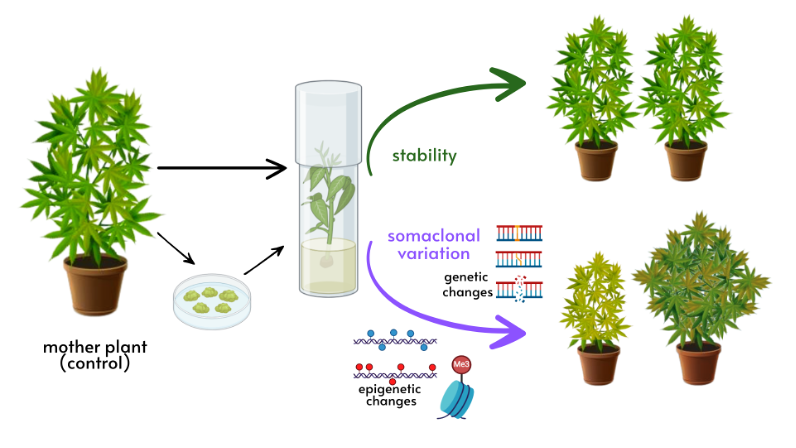
A study published in February 2026 in the Journal of Cannabis Research gives us some real numbers.
The study
A team from Université du Québec à Trois-Rivières, Université Laval and the Quebec propagation company Phytoclone started tissue cultures of three commercial cultivars: 'Critical Purple Kush', 'Green Crack' and 'Gelato'. They kept them in shoot multiplication for 60 weeks, transferring them to fresh medium every 3 weeks.
They sampled the mother plants right before initiation, then sampled the plantlets at every fifth transfer (transfers 5, 10, 15 and 20). They looked at two things:
DNA sequence changes (SNPs, single-letter changes in the genetic code), using a genotyping-by-sequencing method.
DNA methylation, the chemical tags that help turn genes up or down without changing the sequence itself, using whole-methylome sequencing.
What they found
Most genetic changes happened early, then leveled off. Between the start of culture and the fifth transfer (about four months), each cultivar picked up roughly 1,300 to 1,700 new SNPs ('Critical Purple Kush' 1,587; 'Green Crack' 1,284; 'Gelato' 1,743). From the fifth to the fifteenth transfer, they added only about 110 to 180 more. In the authors' words, mutations "mostly occur during culture initiation and the first five subcultures, plateauing afterwards up to the 20th subculture."
Most of those changes were low-impact. The great majority of variants fell outside of genes, in intergenic regions. When the team classified the variants in 'Critical Purple Kush' by likely effect, about 93% were "modifiers" with little or no expected effect, and only 0.1% were classified as high-impact. The other two cultivars followed the same pattern.
Methylation behaved differently. Methylation changes did not spike at initiation the way DNA changes did. Instead they drifted up and down over time, and the pattern differed a lot by cultivar. Most methylation changes were outside of genes (61% to 82%, depending on cultivar), but some fell in promoter and gene regions where they could affect how genes are expressed. The authors suggest that over the long term, changes in methylation, rather than DNA mutations, may be the bigger driver of any decline in genetic stability.
What this means for growers
Tissue culture isn't a freezer, but it isn't a blender either. Plants in culture do change a little, and most of that change appears during initiation, as the plant adjusts from the grow room to life in a jar. After that, the DNA sequence was remarkably steady in this study.
Mother plants change too. The authors note that growers have reported loss of vigor in cultivars after long periods of propagation by cuttings, linked in part to somatic mutations that build up over many generations of mothers. Every propagation method involves cell division. The question is how you manage it.
Keep the original, and plan your refresh. The authors' main recommendation is practical: know your cultivar's starting point, store the original genetic material, and restart from it at set intervals so you never drift away from the plant you selected. That's exactly the logic behind keeping a clean, tested genetic library.
How we approach it at Zennetix. Lines can stay in multiplication for as long as a grower needs them, and so far we haven't seen drift in our lines. We keep watching for it. If a line ever needs a fresh start, we can re-initiate it through meristem culture, the same technique we use to clean up HLVd. And we're building toward the kind of long-term reference library this study recommends, using cold storage and cryopreservation, so the original genetics are always there to come back to.
A few caveats
This study looked at three cultivars under one lab's protocol. The sequencing method samples a portion of the genome rather than the whole thing, and some early SNP counts reflect differences from the reference genome rather than new mutations. Samples were taken in batches from multiple vessels, so later samples aren't always direct descendants of earlier ones. Most importantly, the study measured DNA and methylation, not plant performance: it doesn't tell us whether any of these changes showed up in yield, structure or chemistry. The authors call for exactly that work next.
Bottom line
The best data we have so far says most genetic change in cannabis tissue culture happens at the very start, is mostly low-impact, and then levels off. Methylation is the piece to watch over time. Good tissue culture practice means respecting both: a careful start, a known reference, and a plan to return to the original.
Source
Lefebvre, V., Torkamaneh, D., Deslauriers, S., et al. (2026). Micropropagation of Cannabis sativa: genetic and epigenetic stability assessment over multiple generations. Journal of Cannabis Research, 8, 43. https://doi.org/10.1186/s42238-026-00406-y
Questions about keeping your genetics true-to-type? Email us at sales@zennetix.com.


Comments